
Gastronomy Tour in Kos
Depart Bodrum 08:30 – Return 17:30. 8 hours to become a Greek cook, crush olives, and feast with a three‑generation family.
LISTEN. YOU HAVE EXACTLY 8 HOURS ON KOS.
Not a full day. Not a lazy afternoon. Eight hours of pure, unfiltered, farm‑to‑fork warfare against bland tourism. And we are going to use every single second to rip open the chest of authentic Greek gastronomy, pull out its beating heart, and make you eat it – after you cook it yourself.
The classic day trip? A joke. A slow boat, a limp gyros, a few postcards, and a desperate sprint back to the dock.
This is not that. This is a precision strike. A high‑speed, high‑flavor, high‑emotion assault on the last real village of Kos.
Forget sleeping in. Forget a leisurely breakfast. You will meet us at Bodrum port at 08:00. The catamaran leaves at 08:30 sharp. By 17:30, you will be back on the boat with flour on your shirt, olive oil on your fingers, and a Greek grandmother’s voice in your head correcting your knife technique for the rest of your life.
This is THE OLIVE & FIRE EXPRESS – and seats are vanishing like ouzo at a christening.
08:30 – THE CATAMARAN. NO CABINS. NO NAPS. JUST SPEED.
The fast catamaran cuts through the Aegean like a blade. 50 minutes. That’s all the time you get to stare at the water and wonder if you are brave enough for what comes next. Because most tourists who step onto Kos will go left – toward the souvenir stalls, the fake ancient ruins, the overpriced harbor tavernas.
You will go right. In a private minibus, straight into the spine of the island.
Your guide is not a bored history student. Your guide is a gastronomy hunter – a local who knows which wild oregano smells like lightning and which olive oil will make you weep. She will meet you at the Kos dock at 09:20, and before you can say “latte,” you are rolling past the tourist traps.
Destination: Philippi Village. 16 kilometers inland. Where the air tastes of thyme, pine, and woodsmoke. Where the only traffic jam is a flock of sheep. Where a family has been growing, pressing, and cooking for three generations – and today, they are all yours.
10:00 – PHILIPPI. THE LAST AUTHENTIC HOURGLASS.
The minibus stops in front of a stone house with a vine so thick it looks like a green explosion. And there he is: Stelios. Big hands. Bigger laugh. An apron that has seen a million meals.
“You are late? No. You are exactly on time. Coffee first. Then we change your life.”
First stop: his taverna courtyard. Not a restaurant. His home. His father’s home. His grandfather’s home. You sit under the vine. He brings Greek coffee – thick, dark, sweet as a secret. You sip. He talks. About the village, about the land, about the 200‑year‑old olive tree that still produces fruit every autumn.
This is not a coffee break. This is a handshake. By the time the cup is empty, you are no longer a customer. You are a guest. And guests do not just sit – they work.
10:30 – THE FIELD. THE TRUTH TASTING.
“Follow me. And don’t step on the eggplants.”
Stelios leads you into his field. Not a garden – a field. Acres of tomatoes that taste like they have been arguing with the sun. Peppers that range from sweet to violent. Basil so fragrant it should be illegal.
He picks a tomato. Rubs it on his sleeve. Bites into it. Juice runs down his chin.
“This is what you have been missing. Everything you buy is a corpse. This is alive.”
You will taste that tomato. You will taste a cucumber that actually tastes like something. You will learn why Stelios’s family never uses chemicals – because the soil here has been loved for a century. For the next 45 minutes, he becomes a professor of earth, patience, and the difference between a vegetable that traveled three days and a vegetable that was breathing ten seconds ago.
11:15 – THE BUTIK OLIVE PRESS. LIQUID GOLD DETECTIVE SCHOOL.
Behind the field, under a roof that smells of cold stone and ripe fruit, sits the family’s micro‑factory. This is where Stelios and his mother turn their own olives into extra virgin olive oil that has never seen a chemical, a filter, or a compromise.
He shows you the millstones. The cold press. The stainless steel tanks.
Then comes the test – the part that will ruin every supermarket oil forever.
Stelios pours his oil into a small cup. He warms it in his palm. He tells you to sniff:
“Fruity? Yes. Grassy? Yes. A bite at the back of your throat? That is polyphenols. That is health. That is the real thing.”
Then he pours a cheap, mass‑produced oil. You smell it. It smells like nothing. Plastic. Grease. A lie.
“Now you know. And now you can never go back.”
You will learn the five signs of a great extra virgin olive oil. You will taste the difference between a November press and a January press. By the time you leave this tiny factory, you will be that annoying person at dinner parties who swirls the oil and says, “Hmm. Low polyphenols.”
12:00 – THE KITCHEN. THE MOTHER. THE FIRE. YOU COOK.
This is the moment. The core. The reason you woke up at dawn.
Stelios leads you inside the family kitchen. It is small. It is hot. It smells of garlic, wild thyme, and love. And standing by the stove, hands on her hips, is the mother.
She does not speak much English. She does not need to. She speaks with her hands, her eyes, and the way she grabs a knife like a weapon.
“You want to learn Greek food? Not from a book. From here.” She taps her heart. Then a wooden spoon.
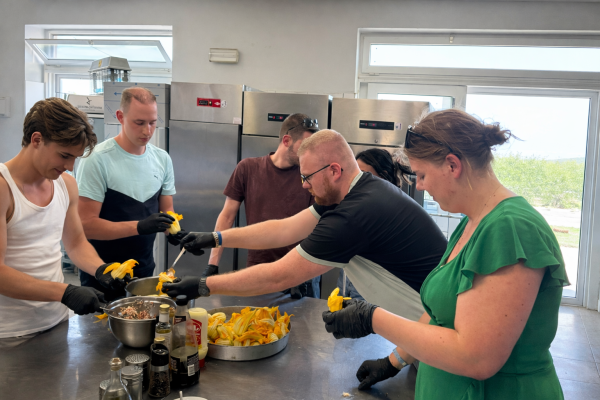
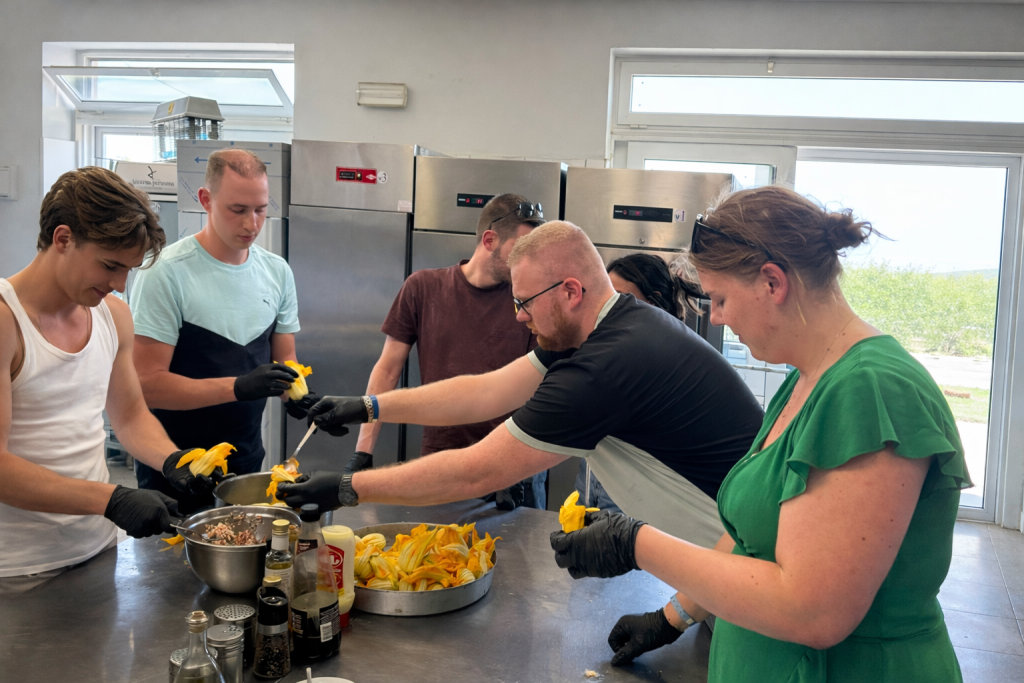
Today, you are the cook. Not a watcher. Not a food blogger. You are pulling up your sleeves, washing your hands, and standing at the counter next to a Greek grandmother who has been making the same dishes for sixty years.
What you will make (with her yelling guidance):
- Horiatiki – The Real Greek Salad. No lettuce. No nonsense. Thick slabs of tomato, cucumber, green pepper, red onion, a block of feta, capers, and a flood of that olive oil you just learned to worship. She will slap your hand if you chop wrong.
- Moussaka – The Queen. Layers of eggplant, potato, spiced meat, and a béchamel that the mother has been perfecting since 1972. You will mess up the first layer. She will sigh. Then she will fix it, and you will learn more in that one correction than from a hundred cookbooks.
- Dolmades – Vine Leaf Rolls. Rice, herbs, a secret that Stelios whispers but won’t let you write down. You will roll each one by hand. The mother will examine every single roll. Imperfect ones go into a separate pot. “Those are for the husband,” she jokes.
- Sarma – Cabbage Rolls. Slow‑cooked in a lemony‑olive oil broth. You will learn the difference between dolma and sarma. And you will never confuse them again.
The kitchen becomes chaos. Laughter. Steam. A dropped spoon. A burnt fingertip. The mother yelling “Opa!” when someone actually flips a moussaka piece without breaking it.
Stelios pours ouzo. Then retsina. Then something clear from a bottle with no label. You stop caring about the time. You stop caring about the ferry. You are inside a moment that feels ancient and brand new at the same time.
13:30 – THE FEAST. THE TABLE. THE REVELATION.
The food is ready. And not just what you cooked. The mother has added her own surprises: a slow‑roasted goat from the wood oven, a potato dish that makes you close your eyes, and bread baked this morning.
The table is set under the vine. The cats gather. Stelios opens another bottle. The mother sits down for the first time all day, wipes her hands, and watches you take the first bite.
This is the moment you realize:
You have never really eaten Greek food before today. You have only eaten airport versions. Tourist versions. This – the sweat, the soil, the three generations, the pressed olive oil, the rolled vine leaf – this is the real thing.
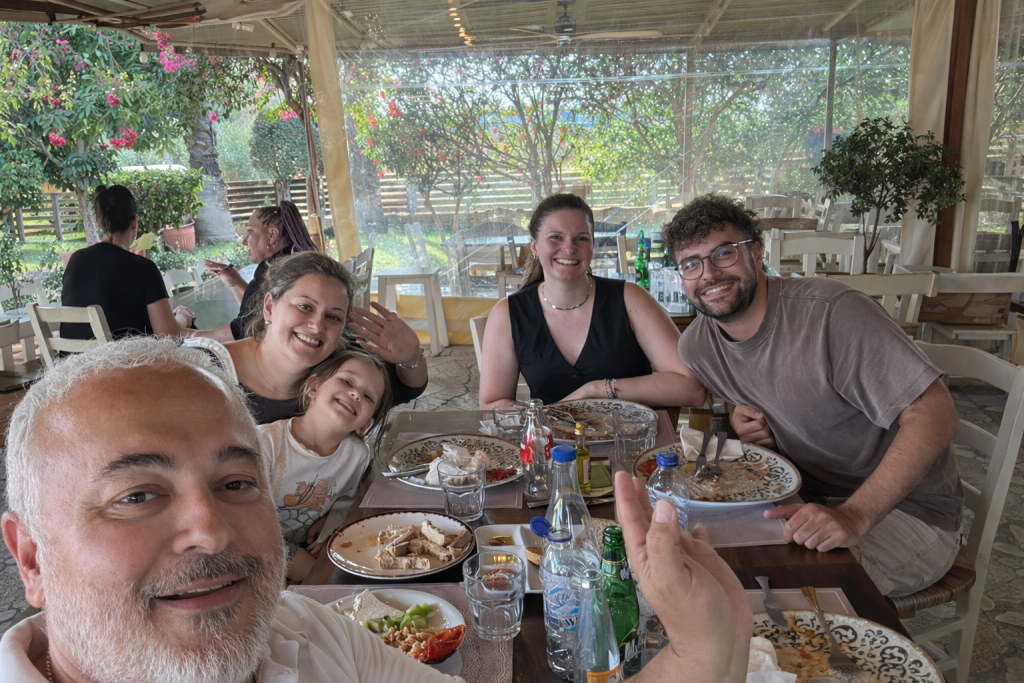
You eat until you cannot eat anymore. Then Stelios brings out yogurt with sour cherry spoon sweet. Then the mother brings out baklava that is not too sweet, not too sticky, just perfect. Then someone produces a watermelon that was picked two hours ago.
You are not full. You are transformed.
15:00 – THE FAREWELL. THE HARDEST PART.
The sun is lower now. You have been in this village for five hours, but it feels like five minutes.
Stelios shakes your hand. Then hugs you. Then makes you promise to come back.
The mother kisses you on both cheeks. She slips a small plastic bottle of olive oil into your bag. “For your salad tonight. So you remember.”
Your guide is already in the minibus. No one wants to leave. But the catamaran does not wait.
As the bus rolls toward Kos town, the conversation is different than it was this morning. No one is talking about shopping. Everyone is staring out the window, replaying the day, already grieving the loss of it.
15:30 – FREE TIME. THE LAST BREATH OF KOS TOWN.
The minibus drops you at the harbor. You have 45 minutes – from 15:30 to 16:15 – to do whatever you want.
Walk the ancient plane tree of Hippocrates. Buy a last‑minute jar of wild thyme honey. Or simply sit at a café, order nothing, and stare at the water, processing what just happened.
But you won’t shop much. Because you already have the only souvenir that matters: a full stomach, a new skill, and the memory of a mother yelling “Opa!” in a tiny kitchen while you learned to roll dolmades like a Greek.
16:15 – KOSAROS. THE FINAL VEDDING.
At the port, you meet your guide one last time. This is the Kosaros farewell – not a rushed wave, but a real goodbye. Names are exchanged. Instagram handles are shared. Someone promises to send photos.
Then you board the catamaran. Departure: 17:30 sharp. As the boat pulls away, Kos shrinks behind you. The lights of Bodrum grow on the horizon.
You are tired. You are happy. You are changed. And you will never look at a bottle of olive oil the same way again.
WHY THIS TOUR IS ABSOLUTELY, DESPERATELY FOR YOU.
Let us be honest.
You could take the slow ferry. You could wander Kos town like a lost sheep. You could eat a mediocre souvlaki from a place that also serves chicken nuggets. You could come home with a fridge magnet and a vague sense of disappointment.
Or you could do this.
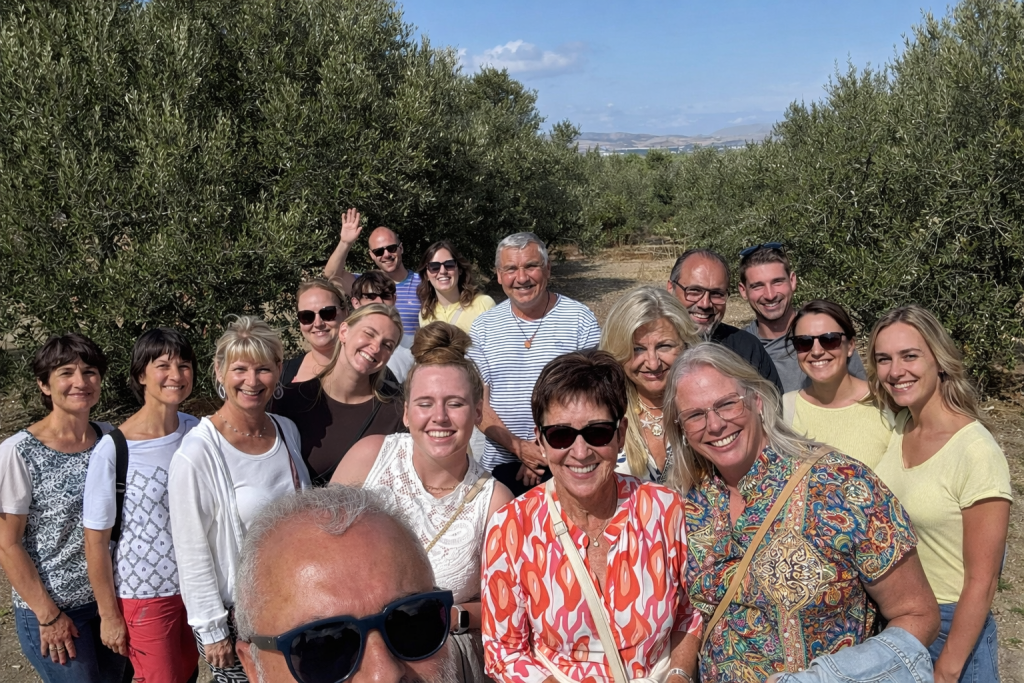
This is not a tour for people who want to check a box. This is a tour for people who want to become something – even for just one day. A cook. A farmer. A temporary member of a Greek family.
You will not just taste Greek cuisine. You will make it. You will argue with a grandmother about eggplant thickness. You will learn the difference between a $10 bottle of olive oil and a $40 bottle that is worth every cent. You will sit in a courtyard that has hosted weddings, funerals, and arguments for over a hundred years.
And here is the aggressive truth: This experience is dying.
Stelios’s family does not do this every day. They are farmers first, cooks second. They only open their home to a handful of guests per week – because authenticity does not scale. You cannot mass‑produce a mother’s recipe. You cannot commodify a sunset over a three‑generation olive grove.
Every time we run this tour, it sells out. And every time, people beg us for more dates. We don’t add them. Because the moment we do, it becomes fake.
So here is your choice:
Book now and spend 8 hours inside a Greek fairy tale.
Wait and spend the rest of your life wondering what that peppery olive oil tasted like.
- Departure Bodrum: 08:30 (meet at port 08:00)
- Return to Bodrum: 17:30 (arrival approx 18:20)
- Included: High‑speed catamaran (round trip), private minibus, English‑speaking gastronomy guide, all farm and factory visits, Greek coffee break, full hands‑on cooking class with Stelios’s mother, all ingredients, the feast with wine/ouzo/raki, 45 min free time in Kos town, all gratuities for the family.
- Not included: Personal shopping, extra alcohol beyond the meal, your inevitable tears when you say goodbye.
- Group size: Absolute maximum 12 people. Usually 6–8. We mean it.
- Physical level: Easy to moderate. You will stand in the kitchen for about 1.5 hours and walk through a field. Wear comfortable shoes. Bring an empty stomach. Leave your diet at the port.
You are reading this because some part of you is tired of the usual. Tired of sanitized travel. Tired of experiences that look good on Instagram but feel like nothing in your chest.
This tour is not pretty. It is messy. It is loud. It involves burnt fingers, broken eggplants, and a Greek mother who will absolutely correct your knife technique in front of everyone.
And it is the single best day you will spend on any Greek island. Period.
Stelios is waiting. The mother is sharpening her knives. The olive oil is dripping from the press.
The only question is: Are you brave enough to cook?